Eight days, half a million miles, and three people in a machine the size of a small room. Follow the flight at its real pace, hear the crew in their own words, and then try the last two minutes yourself.
Choose how to read
Your choices stay in this browser only. Teachers can link straight to a level:airand.space/apollo-11/?path=9-12. Keyboard: the timeline is a slider (arrow keys); Page Up and Page Down jump between phases; in The Landing, arrow keys fly.
Prologue · September 12, 1962
We choose to go to the Moon in this decade and do the other things, not because they are easy, but because they are hard.
The Journey
Drag the timeline, or press play and let the mission run. Earth and Moon are drawn to scale, and so is the distance between them. The spacecraft is drawn far larger than life so you can find it, and the flight path is a simplified sketch tuned to the real mission times.
Simplified trajectory · bodies to scale · spacecraft enlarged
GET ·
1969-07-16 · 000:00:00 GET
Launch
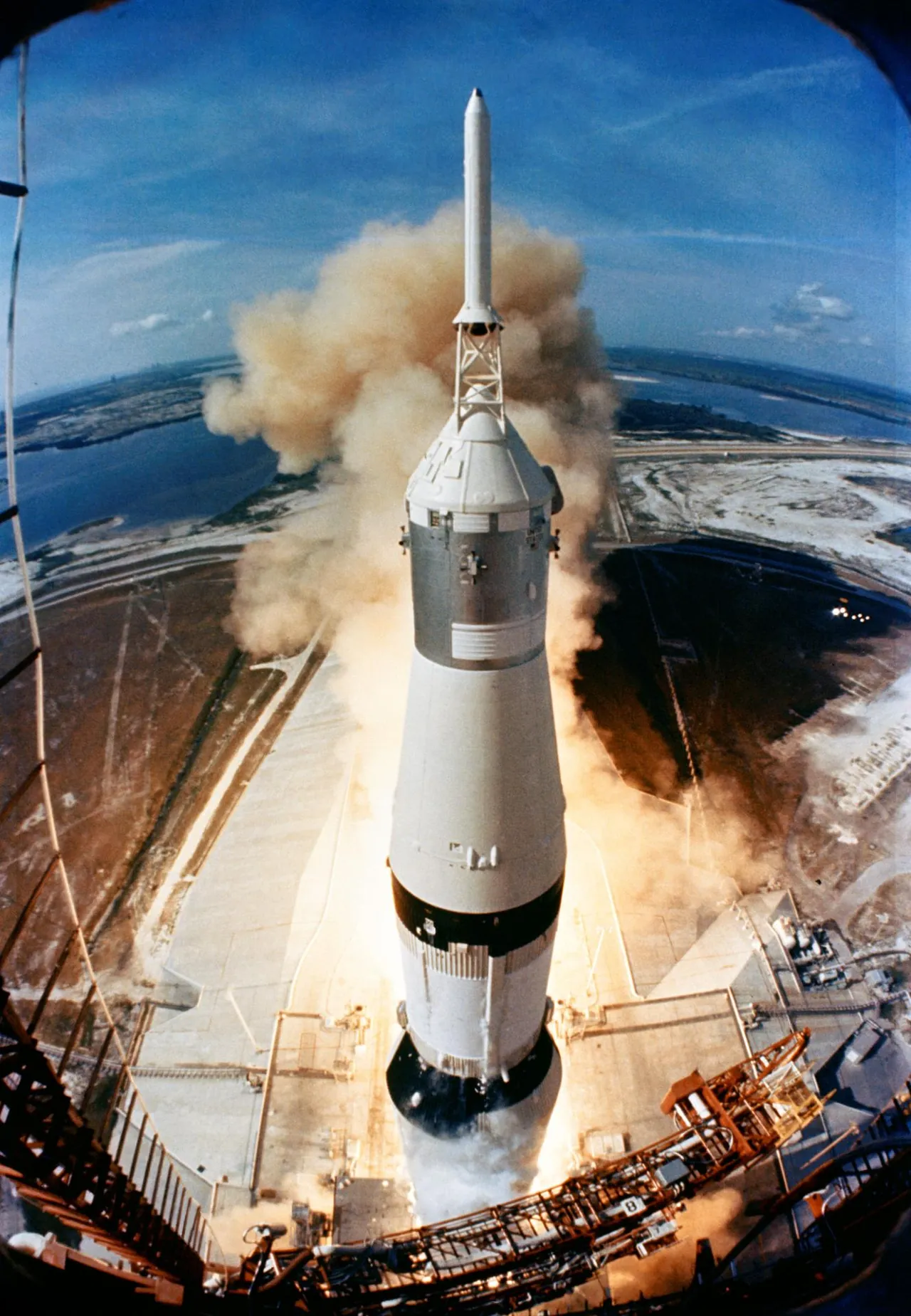
The Saturn V carrying Apollo 11 lifts off from Pad A, Launch Complex 39, Kennedy Space Center, at 9:32 a.m. EDT on July 16, 1969. NASA photo S69-39961. Source.
At 9:32 in the morning on July 16, 1969, the Saturn V rocket lifted off from Kennedy Space Center in Florida. It was as tall as a 36-story building. Three astronauts sat in a small capsule at the very top: Neil Armstrong, Michael Collins, and Buzz Aldrin.
A rocket this big is really three rockets stacked on top of each other. The bottom one did the heaviest lifting and burned out in under three minutes. Then it dropped away, and the next one took over. Less than twelve minutes after liftoff, the crew was circling the Earth.
Range zero, the moment the countdown reached zero, was 13:32:00 UTC on July 16, 1969. The Saturn V was a three-stage launch vehicle. The first stage (S-IC) burned for about 2 minutes 42 seconds; the second stage (S-II) burned until 9 minutes 8 seconds; the third stage (S-IVB) burned until 11 minutes 39 seconds and placed the spacecraft in Earth orbit.
Staging is the key idea: dropping empty tanks and engines means the remaining engines accelerate a lighter vehicle. The Mission Report describes the launch as “essentially nominal,” with the stages cutting off within about a second of plan and the orbit within expected tolerances.
Liftoff: 13:32:00 UTC (9:32 a.m. EDT), July 16, 1969, Pad A, Launch Complex 39, Kennedy Space Center.
First-stage cutoff at 2 min 42 s; escape tower jettisoned at 3 min 18 s; second-stage cutoff at 9 min 8 s; third-stage cutoff at 11 min 39 s.
Before heading to the Moon, Apollo 11 circled the Earth one and a half times. This gave the crew and Mission Control about two and a half hours to check that everything worked. Going around the whole planet took about an hour and a half.
Being in orbit does not mean gravity has switched off. Gravity is still pulling the spacecraft toward Earth. The spacecraft is simply moving sideways so fast that it keeps missing the ground, around and around.
After insertion at 11 min 49 s, Apollo 11 spent about 2½ hours in a near-circular parking orbit, roughly one and a half revolutions, while the crew and ground checked the spacecraft and the third stage before committing to the Moon. The orbit was slightly perturbed by hydrogen venting from the S-IVB stage until restart preparations began at 2 h 34 min.
An orbit is free fall with enough sideways velocity that the curve of your fall matches the curve of the planet. Near Earth that is about 7.8 km/s. Nothing holds the spacecraft up; it is falling the whole time.
Parking orbit insertion at 00:11:49; about 2½ hours (1½ revolutions) before translunar injection.
The orbit was perturbed by low-level hydrogen venting from the S-IVB until 02:34:38, when restart preparations began.
To leave Earth orbit and head for the Moon, the third-stage engine lit a second time and burned for almost six minutes. This push is called translunar injection, or TLI. After it, the spacecraft was moving fast enough to climb away from Earth for three days.
Half an hour later the crew did a careful bit of flying. The command ship, Columbia, turned around, docked nose-to-nose with the lunar lander, Eagle, and pulled it free of the used-up rocket stage.
The S-IVB reignited at 2 h 44 min 16 s and cut off at 2 h 50 min 03 s: a burn of 5 min 47 s. The added velocity raised the far side of the orbit far beyond the Moon's distance. The Mission Report notes the injection was accurate to about 1.6 ft/s, and the resulting path would have brought the spacecraft back to Earth even if the engine never fired again (a free-return trajectory).
At 3 h 17 min the command and service module (CSM) separated from the S-IVB, turned 180 degrees, docked with the lunar module (LM) at 3 h 24 min, and pulled it out of the stage at 4 h 17 min. Translunar coast had begun.
TLI ignition 02:44:16; cutoff 02:50:03 (5 min 47 s).
CSM separation from the S-IVB at 03:17:05; docking with the LM at 03:24:03; LM ejection at 04:16:59.
The injection error was about 1.6 ft/s; the trajectory was a free return.
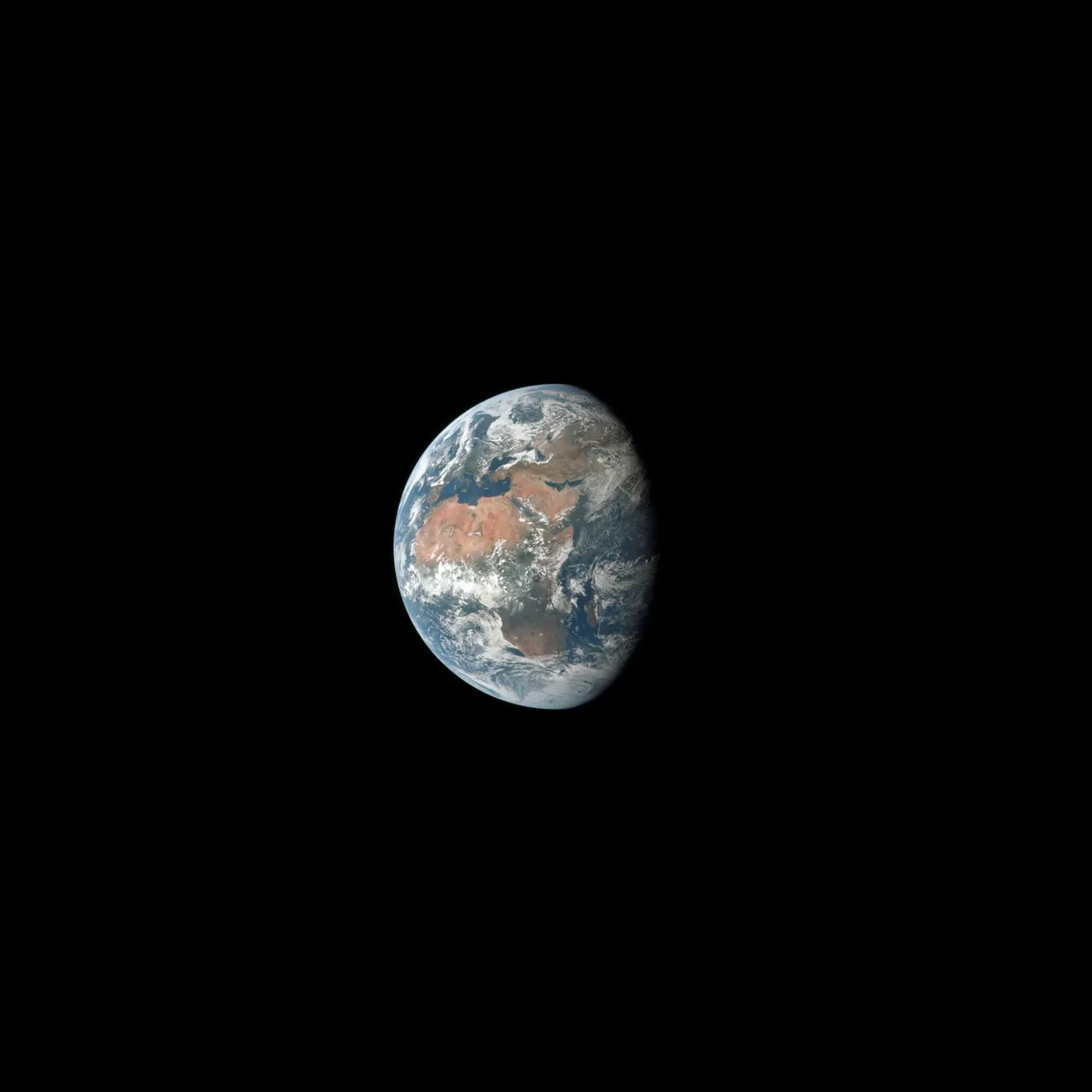
Earth from Apollo 11 on July 17, 1969, during the coast to the Moon. Most of Africa and parts of Europe and Asia are visible. NASA photo AS11-36-5355. Source.
For about three days the spacecraft coasted toward the Moon with its engines off. The Earth slowly shrank behind them, and the Moon grew ahead. The crew ate, slept, checked the ship, and sent television pictures home.
Only one small engine nudge was needed the whole way, about 27 hours after launch, to aim precisely at the Moon. Use the speed control on the timeline to watch the three days go by.
From ejection at 4 h 17 min to lunar orbit insertion at 75 h 50 min, the spacecraft coasted for about 71½ hours under gravity alone. It slowed continuously as it climbed out of Earth's gravity well, then sped up again as the Moon's gravity became the stronger pull. The single midcourse correction, at 26 h 45 min, changed velocity by only about 21 ft/s.
To keep the sunlit side from overheating, the spacecraft rotated slowly in “passive thermal control,” sometimes called barbecue mode. In our simplified model the coast is a single Earth-centered ellipse tuned to match the mission's times; the real path was computed by Mission Control from tracking data.
Coast from 04:16:59 to 75:49:50 (about 71½ hours).
One midcourse correction at 26:44:59, about 21 ft/s.
Pericynthion (closest approach to the Moon) after the correction: 61.5 nautical miles, against a target of 60.
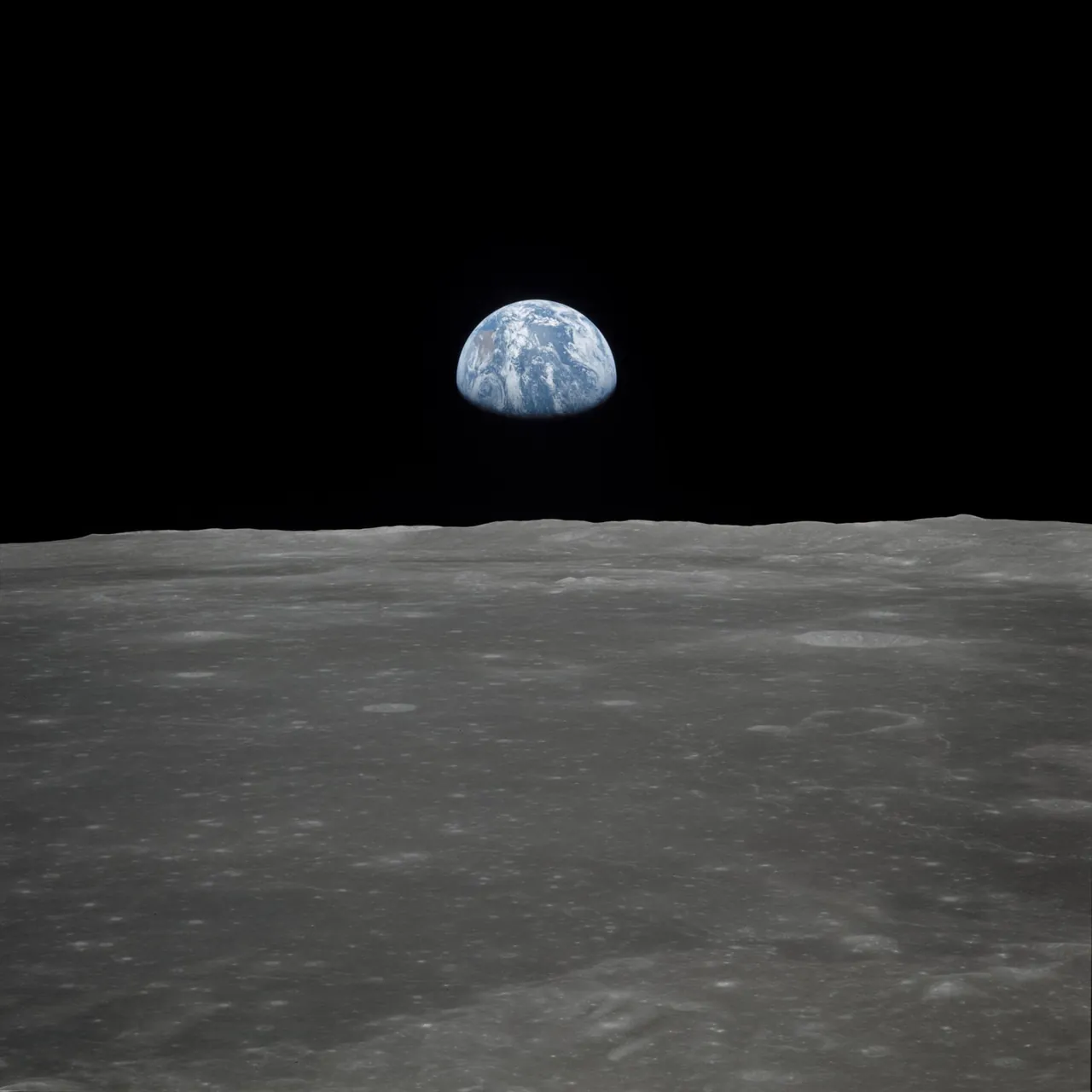
Earth rises over the Moon's horizon, photographed from Apollo 11 in lunar orbit. The terrain is near Smyth's Sea on the near side. NASA photo AS11-44-6552. Source.
Arriving at the Moon, the spacecraft was going too fast to be captured by the Moon's weak gravity. So the big engine fired for about six minutes to slow it down. This burn happened behind the Moon, where no radio signal could reach Earth. Mission Control could only wait.
When the spacecraft came around the edge of the Moon right on time, everyone knew the burn had worked. Apollo 11 was in orbit around the Moon.
Lunar orbit insertion (LOI) was a retrograde burn of the service propulsion system beginning at 75 h 49 min 50 s, on the far side of the Moon and out of radio contact. The resulting orbit was 169.7 by 60.0 nautical miles. The burn ran about 4.5 seconds shorter than predicted because the engine's thrust was slightly higher than expected.
Two revolutions later, at 80 h 11 min 37 s, a circularization burn trimmed the orbit to 65.7 by 53.8 nautical miles. The orbit was deliberately not made circular: the Moon's lumpy gravity field (“mascons”) distorts orbits, and the planners targeted an orbit that would evolve toward the right shape for the landing.
LOI ignition 75:49:50, behind the Moon; orbit 169.7 by 60.0 nautical miles.
Circularization at 80:11:37; orbit 65.7 by 53.8 nautical miles.
The LOI burn was 4.5 s shorter than predicted because of higher-than-predicted thrust.
On July 20, Armstrong and Aldrin floated into Eagle and undocked from Columbia, where Collins stayed in orbit. Eagle's descent engine fired for about twelve and a half minutes to bring it down from orbit. In the last minutes, Armstrong saw that the computer was taking them toward a crater full of boulders, so he flew the lander by hand to a smoother spot.
You can fly those last minutes yourself in The Landing below.
Undocking came at 100 h 12 min. The descent orbit insertion burn at 101 h 36 min lowered the orbit's low point to about 50,000 feet, and powered descent initiation (PDI) at 102 h 33 min 05 s started the 12½-minute braking burn. The onboard computer flew the braking phase; the Commander took manual attitude control at about 600 feet and used the rate-of-descent mode from about 400 feet, landing roughly 1,100 feet beyond the original aim point to avoid a crater.
Five computer alarms (four 1202s and one 1201) occurred during descent. They meant the computer was overloaded and dropping low-priority work; it never lost the guidance task. Mission Control's call was “GO.” The propellant low-level light came on at about 102:44:28, indicating roughly 116 seconds of firing time remaining. Fly it yourself in The Landing below.
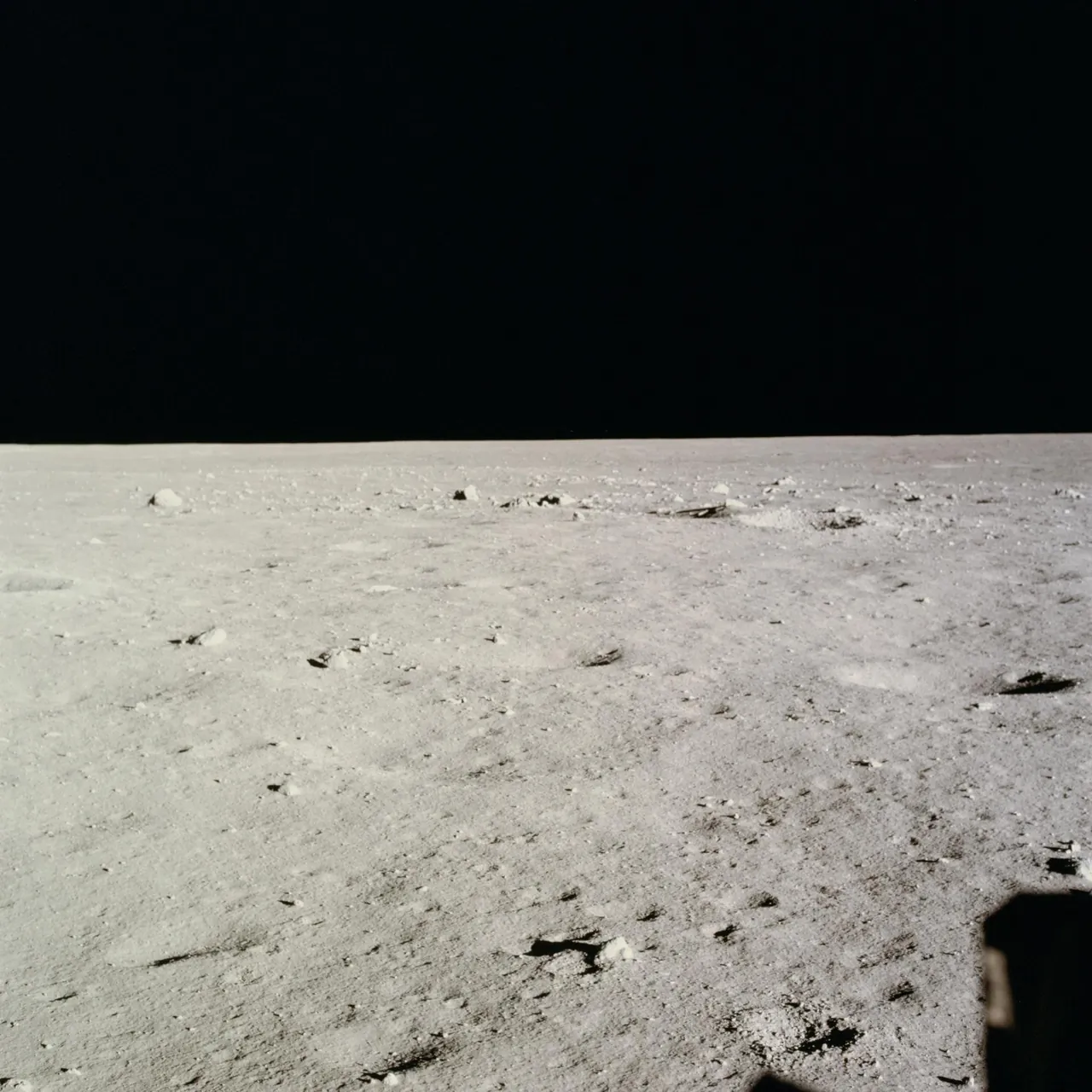
Tranquility Base through Eagle's right-hand window, shortly after landing on July 20, 1969. Small rocks and craters lie between the LM and the horizon. NASA photo AS11-37-5458. Source.
At 3:17 in the afternoon, Houston time, on July 20, 1969, Eagle touched down on the Sea of Tranquility. It landed gently, sliding sideways about as fast as a slow walk. Armstrong radioed the words that gave the landing site its name: “Houston, Tranquility Base here. The Eagle has landed.”
The two astronauts spent the next few hours checking the lander, eating a meal, and getting their suits ready. They decided to go outside earlier than the plan said.
Landing came at 102 h 45 min 40 s (20:17:40 UTC) at 0° 41′ 15″ N, 23° 26′ E on the Sea of Tranquility, about 4 miles from the targeted point. Touchdown velocity was negligible forward, about 2.1 ft/s to the crew's left, and 1.7 ft/s vertical: well inside the landing gear's limits. The right and forward footpads touched almost together.
The crew ran a full postlanding checkout for about two hours, ate, and elected to begin surface operations early rather than take the planned rest period.
Landing 102:45:40 (20:17:40 UTC; 3:17:40 p.m. in Houston, 4:17:40 p.m. Eastern Daylight Time), Sea of Tranquility, 0°41′15″ N, 23°26′ E.
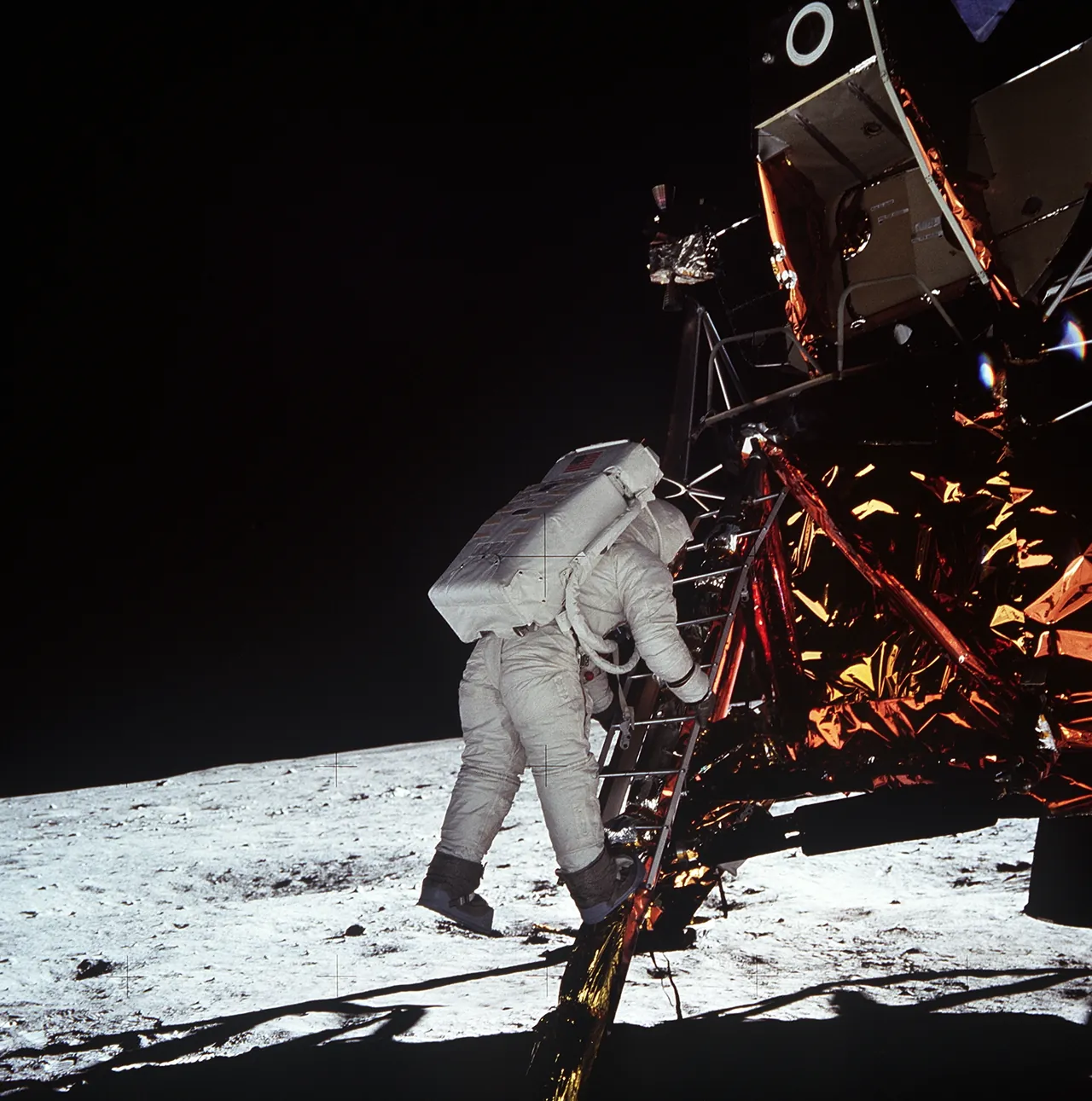
Buzz Aldrin comes down Eagle's ladder, photographed by Neil Armstrong, who had already stepped onto the surface. Armstrong's own first step exists only as television footage. NASA photo AS11-40-5868. Source.
At 9:56 at night, Houston time, Neil Armstrong stepped off Eagle's footpad onto the Moon. A television camera on the lander showed it to hundreds of millions of people on Earth. Buzz Aldrin followed about twenty minutes later.
They walked, hopped, collected rocks and soil, set up science experiments, planted a flag, and took photographs for about two and a half hours. Then they climbed back in. The next day Eagle's top half blasted off to rejoin Collins in orbit.
The hatch opened at 109 h 07 min, and Armstrong's boot touched the surface at 109 h 24 min 15 s (02:56:15 UTC, July 21). The crew deployed a passive seismometer, a laser retroreflector (still used today to measure the Earth–Moon distance), and a solar-wind collector, and gathered 47 pounds of rock and soil. The moonwalk lasted the planned 2½ hours; the hatch closed at 111 h 39 min.
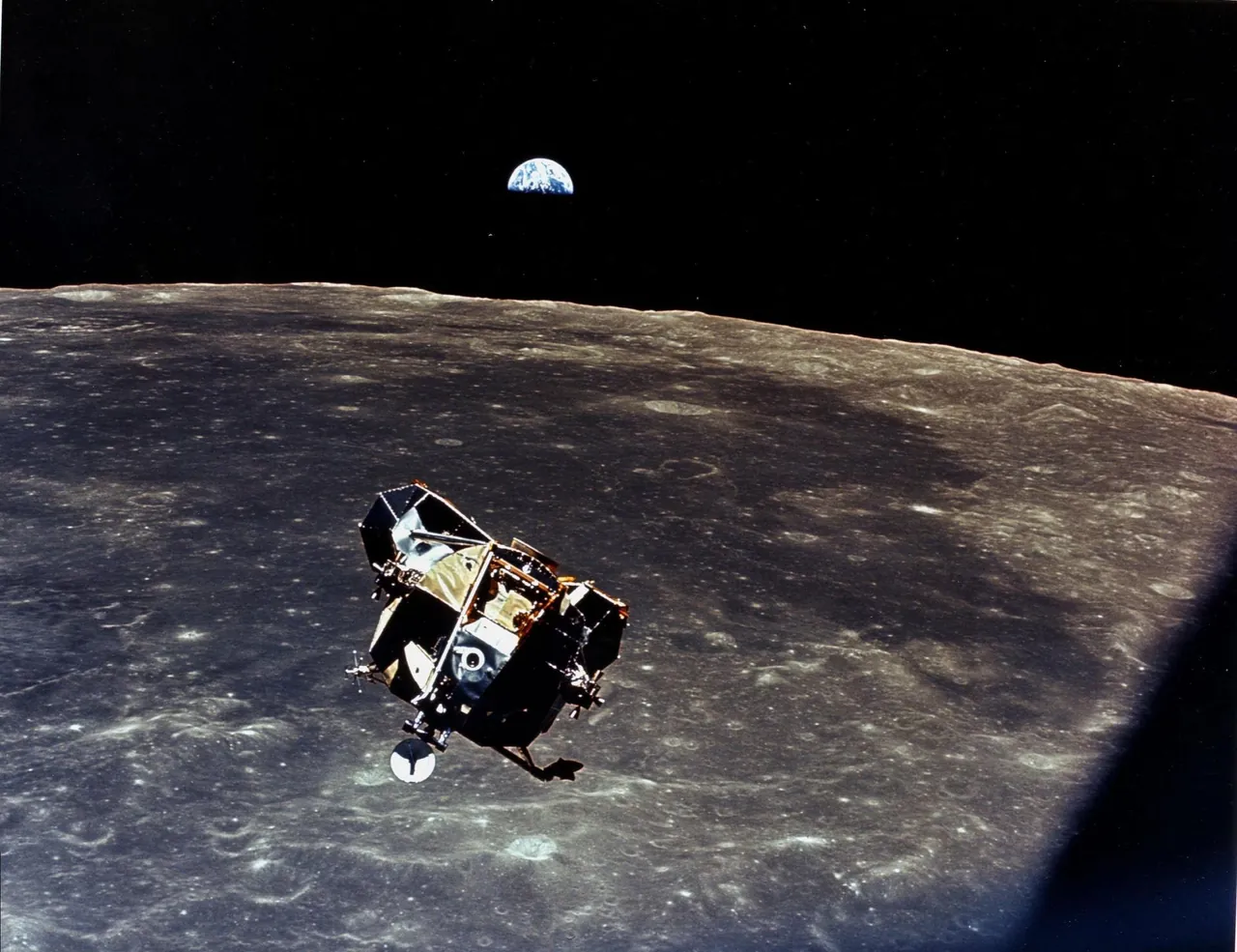
After 21 hours 36 minutes on the surface, the ascent stage lifted off at 124 h 22 min 01 s, using the descent stage as a launch pad. Docking with Columbia came at 128 h 03 min. The ascent stage was jettisoned in lunar orbit two hours later.
Hatch open 109:07:33; first step 109:24:15 (02:56:15 UTC, July 21); hatch closed 111:39:13.
Eagle's ascent stage, carrying Armstrong and Aldrin, returns to Columbia on July 21, 1969, with a half Earth behind. Photographed by Michael Collins. NASA photo AS11-44-6642. Source.
To leave the Moon, Columbia's big engine fired for two and a half minutes while behind the Moon. That sped the spacecraft up enough to escape the Moon's gravity and fall back toward Earth. The trip home took about two and a half days.
Near the end, the crew cast off the service module (the part with the engine and the big tanks). Only the cone-shaped command module, with its heat shield, came home.
Transearth injection (TEI) was a 150-second service propulsion burn starting at 135 h 23 min 42 s, during the 31st lunar revolution. It achieved its velocity change to within 1.2 ft/s of plan. One midcourse correction of 4.8 ft/s, at 150 h 30 min, set the entry flight-path angle to −6.51°.
The command module separated from the service module at 194 h 49 min and reached entry interface (400,000 feet) at 195 h 03 min 06 s. Peak deceleration was 6.56 g. Weather in the recovery area moved the splashdown point 215 miles downrange.
TEI ignition 135:23:42, a 150 s burn on revolution 31; velocity change within 1.2 ft/s of plan.
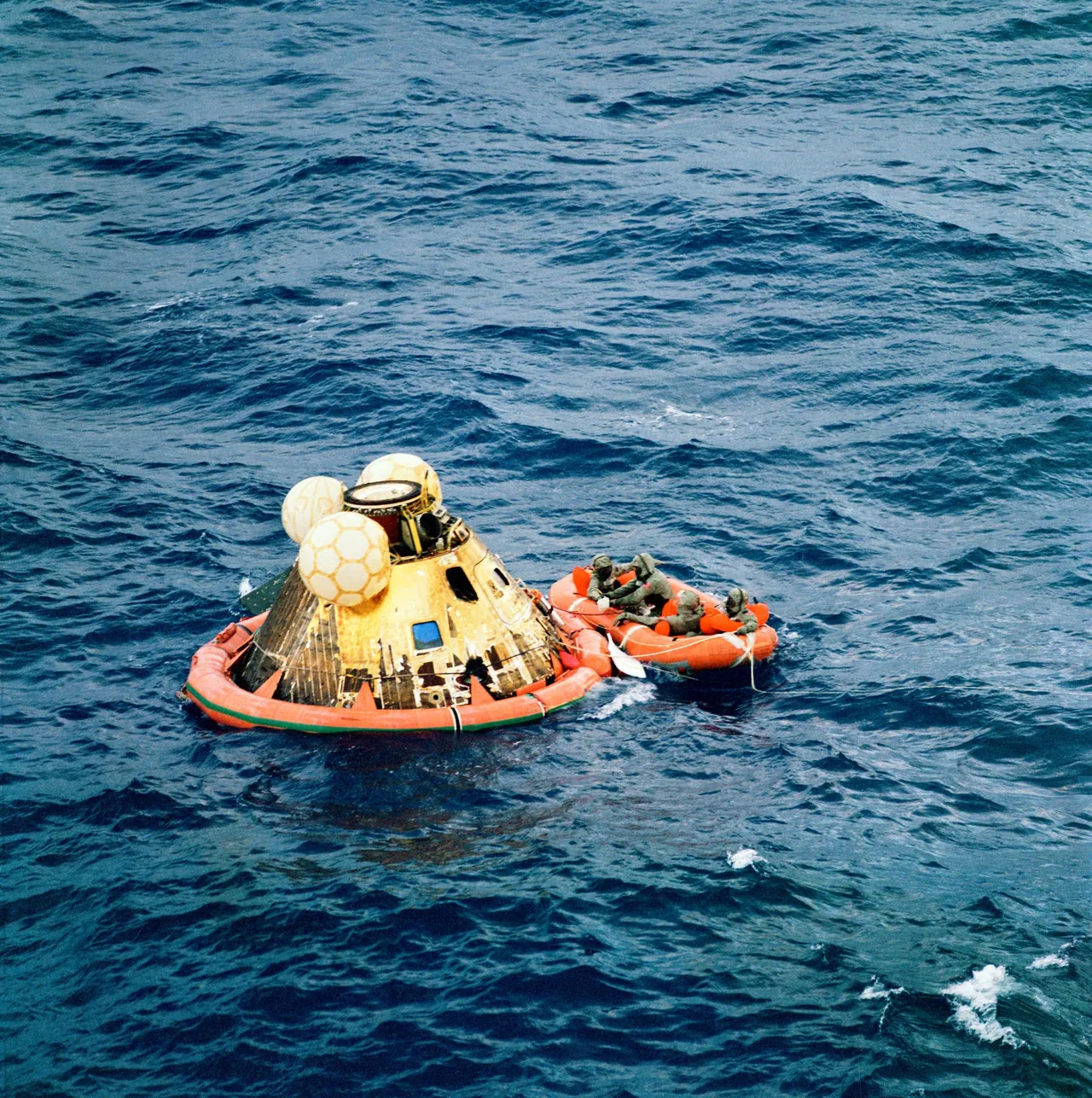
The crew wait in a life raft for a helicopter from the USS Hornet on July 24, 1969. All three, and the Navy swimmer with them, wear biological isolation garments. NASA photo S69-21698. Source.
Eight days after launch, the command module came through the atmosphere glowing hot, opened its three big parachutes, and splashed into the Pacific Ocean on July 24. Helicopters from the aircraft carrier USS Hornet picked up the crew.
Because nobody knew for sure whether the Moon had germs, the astronauts put on special suits and lived in a sealed trailer for weeks afterward. They were fine. The goal set by President Kennedy in 1961 had been met with five months to spare.
Splashdown came at 195 h 18 min 35 s (16:50:35 UTC, July 24) at 13° 19′ N, 169° 09′ W, about 8 days 3 hours after liftoff. The crew donned biological isolation garments in the raft, were flown to the USS Hornet, and entered the Mobile Quarantine Facility along with the lunar samples for the trip to the Lunar Receiving Laboratory in Houston. The command module was recovered about three hours after landing.
The Mission Report's last sentence: “With the completion of Apollo 11, the national objective of landing men on the moon and returning them safely to earth before the end of the decade had been accomplished.”
Splashdown 195:18:35 (16:50:35 UTC), 13°19′ N, 169°09′ W, Pacific Ocean; prime recovery ship USS Hornet.
Crew wore biological isolation garments and entered the Mobile Quarantine Facility.
You have Eagle at about 600 feet, coming down over a boulder field, with the fuel the real crew had. Throttle the descent engine, tilt to cancel sideways drift, and set down gently on the smoother ground. Lunar gravity is one-sixth of Earth's and there is no air, so the engine is all you have.
Guided. Plenty of fuel, and the lander takes over and settles gently on its own if a touchdown would be unsafe. Nobody fails Guided.
Standard. Enough fuel for a careful landing. A hard landing shows you what went wrong and lets you try again.
Historical. About the fuel Eagle really had after the low-level light: roughly two minutes of engine time at a hover. Eagle started this part at about 600 feet.
Altitude
Descent rate
Sideways
Fuel
Throttle
Tilt
Time
LOW LEVELPROG ALARMAUTO HOVER
What the readouts mean
Descent rate is how fast you are falling. The landing legs can take about 2.5 meters per second, roughly a brisk walk. Sideways is how fast you are sliding; keep it near zero or a leg can catch. Tilt is how far you are leaning; land level. Fuel is the only thing holding you up.
In real life, the computer flew most of the way down. Neil Armstrong took over for the last part because it was heading for a crater full of boulders. He landed with less than a minute of fuel to spare.
The model
A fixed-timestep integrator (120 steps per second) applies lunar gravity of 1.62 m/s² and the descent engine's thrust along the lander's axis, tilted by your pitch angle. Thrust is throttleable from 10% to 100% of 45 kN; propellant flow is thrust ÷ (Isp × g₀) with Isp = 311 s, so the lander gets lighter as it burns. Touchdown is safe at under 2.5 m/s vertical, 1.2 m/s lateral, 6° of tilt, and not on a boulder or a slope over 12°. This is a teaching model, not a flight simulation: there is no fuel slosh, no landing radar, and no computer, and the lander eases back to level when you release the tilt keys, which the real LM did not do on its own.
Historically: manual attitude control began at about 600 feet, the rate-of-descent mode at about 400 feet, the low-level light at about 102:44:28 with roughly 116 seconds of engine time remaining, and touchdown at 102:45:40 at about 1.7 ft/s vertical and 2.1 ft/s lateral (Mission Report 5.3, 5.4, 9.8.3).
Compare Kitty Hawk. The Wrights needed air: their wings turned moving air into lift, as the wind tunnel shows. Eagle had no air at all. With nothing to push against, a lander needs rockets for everything: slowing down, steering, hovering, even staying upright. Why can't a lander glide?
Apollo 11: The Eagle has landed (with Mission Control's reply)(1969-07-20, 15 s)
Neil Armstrong, Charles Duke (CAPCOM, Mission Control)
Houston, Tranquility Base here. The Eagle has landed. / Roger, Tranquility, we copy you on the ground. You got a bunch of guys about to turn blue. We're breathing again. Thanks a lot.
Third-stage shutdown and “confirmed GO for orbit”(1969-07-16, 42 s)
NASA public affairs commentator, Bruce McCandless (CAPCOM), Neil Armstrong
Commentator: Shutdown. Shutdown right on time. / Armstrong: 101.4 by 103.6. / McCandless: Roger. Shutdown, and we copy 101.4 by 103.6. … Apollo 11, this is Houston. You are confirmed GO for orbit. … The booster is safe.
One minute to translunar injection(1969-07-16, 17 s)
NASA public affairs commentator, Bruce McCandless (CAPCOM), Michael Collins
Commentator: And we're a minute from ignition. / McCandless: Apollo 11, this is Houston. Slightly less than one minute to ignition, and everything is GO. / Collins: Roger.
Loss of signal before lunar orbit insertion(1969-07-19, 38 s)
NASA public affairs commentator
Commentator: We've had loss of signal as Apollo 11 goes behind the Moon. We were showing a distance to the Moon of 309 nautical miles at LOS, velocity 7,664 feet per second. … We're 7 minutes 45 seconds away from the LOI number one burn, which will take place behind the Moon, out of communications.
Back in contact after the burn: the LOI burn status report(1969-07-19, 91 s)
Bruce McCandless (CAPCOM), Michael Collins
McCandless: Apollo 11, Apollo 11, this is Houston. How do you read? … Could you repeat your burn status report? We copied the residuals and burn time, and that was about it. Send the whole thing again, please. / Collins reads the burn report: burn time, residuals, fuel and oxidizer remaining, and the orbit … / McCandless: Roger. We copy your burn status report, and the spacecraft is looking good to us on telemetry.
Gene Kranz (Flight Director) and flight controllers, Charles Duke (CAPCOM), Buzz Aldrin
Kranz polls the room: all flight controllers, go/no-go for landing. Retro? GO. … / Duke: Eagle, Houston. You're GO for landing. Over. / Aldrin: Roger. Understand. GO for landing. 3000 feet.
Every date, time, and figure on this page comes from the NASA documents below. Times are ground elapsed time (GET), counted from range zero at 13:32:00 UTC on July 16, 1969. The volunteer-edited Apollo Flight Journal and Lunar Surface Journal were not copied from.
Apollo 11 Mission Report (MSC-00171), November 1969, NASA Manned Spacecraft Center. All event times (Table 3-I), descent events and alarms (Table 5-I), landing dynamics (5.4), parking orbit and injection (7.2, 7.3), maneuvers (7.4), and the propellant low-level light (9.8.3).
Deep Star Maps 2020, NASA Scientific Visualization Studio. Star background, built from the Hipparcos, Tycho-2, and Gaia catalogs.
NASA Image and Video Library, NASA. Mission photographs S69-39961, AS11-36-5355, AS11-44-6552, AS11-37-5458, AS11-40-5868, AS11-40-5903, AS11-44-6642, and S69-21698.
Imagery
CGI Moon Kit: LROC WAC color mosaic with poles, 4k. NASA's Scientific Visualization Studio (Ernie Wright, USRA; Noah Petro, NASA/GSFC); Lunar Reconnaissance Orbiter Camera data. NASA SVS product built from LRO data; not copyrighted. Credit NASA SVS.
Blue Marble: Next Generation, July 2004, with topography and bathymetry (5400x2700). NASA Earth Observatory (Reto Stöckli), from MODIS data. The Earth Observatory asks that anyone republishing Blue Marble: Next Generation credit "NASA Earth Observatory." July chosen to match the season of the flight. Cloud-free composite, so no clouds are shown.
Deep Star Maps 2020: starmap_2020_4k.exr (celestial coordinates). NASA's Scientific Visualization Studio (Ernie Wright), built from the Hipparcos, Tycho-2, and Gaia star catalogs. NASA SVS product; not copyrighted. The underlying catalogs are ESA data products; the rendered map is NASA's. Tone-mapped from the linear EXR for display.
Audio and imagery courtesy of NASA, used under NASA's Media Usage Guidelines. airand.space is an independent educational site; nothing here is endorsed by NASA. The NASA insignia and logotype are not reproduced in our graphics or models. Spacecraft models are our own simplified drawings from public dimensions.